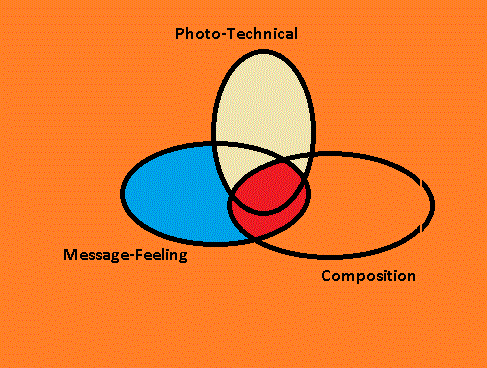
It reminded me of the challenges of both disciplines - team work, stregnth and wisdom on the one while a sense for a composition and wisdom on the camera side.

The biggest challenge in sailing photography to me is not having a water resistant camera. For others it is likely to be getting close enough to the action or being able to predict when the most exciting and interesting shots can be captured. The first is fixable with either a different camera system, Pentax and Olympus offering mid end weather sealed systems, while on the other, asking some spectators or race organisers what is going to happen can solve problems of where to stand on the shore, or where to go on the water in a motor boat to catch those shots.
My other challenge is not really my own- it is the percieved need for new fangled stuff all the time and how much more "obsolete" camera bodies are considered these days after they are but a few years old. When i started SLR 35mm photography, you would see a lot of older folk with good Nikons and Canons from the early 70s slung around their necks, seperate light meter round their wrists. There was also the OM revolution and the followers at Pentax and Ricoh. All before we went all "electronic operating system" and then much worse, APS film cameras were pushed onto the market to the detriment of photography in general. These days many hobby photographers think it laughable that I persist with a body launched 7 or 8 years ago, but as I stated before, it is way in excess of what was available to me in the 1980s.
Main system equipment aside, what do you need for a good day's yattin' phottin'?
Firstly you don't necessarily need a boat or loan of a boat. You do then need to be within reasonable distance of sailing, and that means either knowing that the racing is at least in part, going to come near land, or positioning yourself at a natural narrows where boats have to sail regardless. Also another alternative is as I found out, to use local route ferries or tourist boats when racing or other 'muster regattas' are on, such as over to the Isle of Wight, Kilcreggan on the Clyde, Syndey Harbour or San Francisco bay area. How I cursed not having a good camera on the way past Alcatraz when a rather infamous I 14 sailor, "The Captain" Came shooting past the "Rock" in his high performance dinghy, bright spinnaker resonant in the mute californian colours.
Lens choice, given that you have them. Firstly for dock side photting a 28mm eq zoom or prime is quite sufficient and unlike the wider end, does not distort perspective so much on yachts that you become very aware of the wide treatment. For example - 28mm eq

A typical kit zoom in the range 28-85mm eq ff, will provide for on shore images not only dockside, and passing boats close by on the wide end, but what I really personally like and that is "in context" shots of boats in their often beautiful or interesting seaside land- or town -scapes. At the long end you will get kind of cut off shots though of boats racing at distances of a few hundred yards, which are neither between having enough background to give context nor enough detail to be a photo of a boat. The same will be true of primes in the eq nifty fifty 50mm to portrait semi telefoto, but the added speed of a fast prime at 120mm to say 150mm can make up for lack of composition freedom in capturing detail shots when boats are near enough.
When I say detail shots, this is often in the sailing magazines close enough to recognise crew members, which helps sell copy or gives an otherwise anonymous top competition boat, a relevant human face, such as the instantly recognisable handsome profile of Sir Ben Ainsley. Alternatively, they can be technical shots, which show either nice detail on a wooden boat, the motion of the boat in the sea, or particular action or mishap sequences. In harbour the "wide to mid" zoom will suffice, but for shots at greater distances you need to go up to higher telefoto ranges for both detail shots, and whole boat shots when they are further away up the racing course.
At the telephoto end, I have looked at my own EXIF focal mm, and some other folks on and off the water. From the land, I use quite a lot of 300mm for boats sailing on their race courses, but once out in a boat I find that the shots are split three ways in fact:
Whole boat circa 85mm

cropped action in context 100-120

Close up of action and crew 200- 220

The last shot is a bit misleading probably taken at about 80 actually, because we could drive close to them since they had finished racing and were enjoying the spinnaker run to the harbour. But usually this type of close up would be on the race course, keeping a respectful distance at 200mm approx. More on positioning and courtesay later.
I find the longer end off shore is pretty unworkable above 220mm because you usually are bobbing about in a RIB or small boat, so framing shots becomes difficult as can even getting focus on the boat rather than fore or back ground points. With f stops on my kit being lower, the shutter speed drops too low on programme, or the images get too dark on S, or worse, if you have forgotten auto ISO then it bumps up high.
I recommend using shutter prioirty at base ISO, there is usually more light than you think at first and shadows and quarter tones can be lifted in post. Shutter speed wise, I find that I cannot get sharp images by in large at under 1/320th and prefer at least 1/500th. Remember if you have a fast lens that this will be pushing the aperture more open and reducing your depth of field, which can be an issue for example here :

If you look closely, you can see that the depth of field is quite shallow and the nice, shiny chrome winches are out of focus, while the hatch is sharp. Be aware to too thin a DOF with boats.
On exposure and light conditions, the vast majority of boats white or light coloured sails and also a large number have white hulls these days, and even ye olde varnished hulls reflect a lot of light. Also as mentioned there is a lot more light around at sea because so much reflects up from the water. I prefer to use a polarising filter which reduces reflections and total, scattered light from the sea and therefore that kind of odd brighter blue in images from the sea. This helps with texture of the sea, while also helping tone down the white of hulls and sails allowing more detail to come out. White, blocky hulls and sails detract from photos IMHO and a polarising filter is a good means to vastly reduce this glare, while maintaining a balanced exposure.
Of course a digital optimised polarising filter reduces the scene by up to -2EV. Alternatively a ND (neutral density) -0.5 or -1.0 EV filter can be used to achieve some of the effect, and also open the aperture up just a little more to get thinner DOF on very bright days, when you want to throw the background.
Once on the water, in a small boat, it is pretty desirable not to change lens because no matter how waterproof the camera is, when the body cavity is exposed, it is highly vulnerable to water, and salt water is so much more dangerous. Filters can also be fiddely to mount while bobbing about, which is another advantage of a polarising filter because you can vary the darkness or density by rotating it. Also given my tips based on years of photting myself and recent EXIF checks on some 'pro' flickr images, it is best to have a zoom lens with a range of around 80 to 250mm, and not change lenses. "Big Whites" or those "Bigma" long telefotos with sub f5.6 apertures, are the reserve of either land based photting or being on quite a substantial vessel where roll and spray are minimal for the same weather conditions.
Camera techniques out of the way, as with any sports photography, or landscape photography if you like context as I do, knowing your subject and what is about to happen next makes the difference between " i took some shots at a sunny regatta" to the "wow, see what we captured!" Direction of light and time of day are important, with the shadow cast by the sails to one side of boat something to either avoid or take advantage of. For the non sailor reading this, generally speaking boats under sail go through three interesting 'states' and do a couple of interesting manoevres in terms of action beyond "boat heeled over on water"
1. Beating - this means the boats have their white sails closely hauled in, with often elegant curves on their trailing edges. They are sailing up towards the wind, so you can work out where they are going to be next, as they zig zag in that direction.


From the front of the boat, approaching you is the best angle usually, with the bow wave and crew being points of interest, and worth taking multiple shots at high shutter speeds to select the most interesting wave or crew shots.

2. Reaching - This is when boats cross the wind at about right angles, and for many boat types this is their fastest point-of-sail. Often racing boats will have spinnaker up, and out to one side. Sometimes this angle can put a lot of pressure on the sails, and the helmsman is on a knife-edge of being overpowered and spun round into the wind in what is known as a "broach", in spectacular fashion sometimes. One note is that the boats will be sailing fast away from where ever you are stationed.
3. Running - Here the wind is behind the boat, and the white sails are either pressed out, often like "goose wings" on either side of the boat, or on many racing boats, the bright spinnaker will be most prominent, out to one side of the boat. Given a good light direction, then this can make for spectacularly colourful shots, and also with a degree of shadow with back light, interesting semi silouhette shots can be had. Here the light was failing, and I had a polariser on a non WR lens, so this is how it turned out, a little dark and flat:

The manoervres of interest racing boats do are
1) Tacking their bows through the wind in order to zig zag up to the direction the wind is blowing from
2) Gybing - the opposite, swinging their sterns through the wind with it behind them, and changing sides with the sails, often in interesting fashion with the spinnaker up.
3) Starting - Most boat races have a common mass start, so the boats line up and start all at once. In competitive fleets this means a neat line of boats which is amenable to a 28-35mm from the water. It can be very difficult to spot a given boat btw. It is the sprint, the most stressed point in sailing and crashes do happen.
4) Taking up and down sails (hoist and drop/douse). Usually racing photographers get shots of the spinnaker work as it is a coloured, interesting sail and involves a lot of team work on deck to handle up and down- see image above of a boat 'fishing' with its spinnaker, while the crew do their best to haul it onboard again after it was droped. But other sails can be just as interesting.

Other Equipment
I am going to invest in a second weather resistant camera, most likely the Pentax K series with a single, WR lens the 18-135 (just the ticket as it covers all my usual focal lengths, and with the latest 16 and 20 / 24 mpx sensors without AA filter, cropping can compensate for lack of 300-400mm reach) , but for those of you maybe either with a water proof DSLR or not, a second waterproof 'tough' camera like the Olympus TG4 or a good water resistant mobile can be a good option, despite the fixed or short focal ranges- here a boat is handy to 'leg zoom' near to the action, while often tough compacts and mobiles have a nice do it all 35mm FF eq focal legnth.
Weather jackets for cameras are a good idea for any DSLR camera on the salty sea, because salt is not worth the risk of getting into your camera- a single tiny grain will destroy a sensor or lens mechanism. No amount of being careful will stop a sudden wave splash reaching you on a small, open boat. A full waterproof diving box may be a bit excessive, but if you have many thousands of spondoolics in equipment, worth perhaps the bother. Water proof 'kayaking' bags are a good idea too, just taking a single camera 'snout pouch' bag as I say on a RIB (rigid hull inflatable boat ) or the like,m you dont want to change lenses really at sea.
Tripods are ok for cruise liners, but on a small boat or busy public ferry alike, you are better with a monopod to add maybe that one to two stop benefit in steadyness, while also synchronising with the hull's movement on the water, so at least cancelling out your own body's weather leg movements and getting you used to when you will have the subject in frame as you bob up and down. IBIS/ILIS andbest shot selection, will generally speaking be enough to compensate in light conditions at mid shutter speeds for the combined effects of your boats' movement, your body's movement and the subjects movement.
"Eplilogue" in a non Police Squad sense
I hope this has been of some use and inspiration to sailors in particular, to get out and take shots of their sport from a motor boat or even land. Use your knowledge of how races operate to position yourself for the best images, and decide what type of shot you are setting up for. Remember to get out of the shadow side of the yacht or course unless you are looking for silhouette effects that is. Take bursts of photos in manoervres, when boats cross each other or if you are trying for a close up 'people shot' -. Otherwise for 'in context' shots or general shots, position yourself and wait until the boat is at the sweet spot, and perhaps use an exposure bracket series if light conditions have either high contrast or very flat light. Remember to just check that the camera is focused on the points of interest or tracking the boat well, the dof is not too shallow on the subject, you are using shutter priority at say 1/500th or faster, that you are not overexposing white sails and hulls or getting that unatural 'denim' blue from the sea.
For the non sailor, get to know the basics of sailing and racing and look up some youtube clips to understand what boats are up to and when is interesting to get shots. Being on land may severly restrict you if there are no racing bouys near by, but 'narrow' sounds, harbour entrances or peninsulas can get you close to the action. As can using a ferry or tour boat if you cannot persuade someone to take you out in a boat and spectate actively.
Remember that a RIb infront of a boat racing can be both a destraction, a potential collision hazard and casue a wave as you gvet out of the way which can slow a racing boat down,so keep the engine running keep clear by several of their boat legnths , don't make large waves near competitors or which will roll through the whole fleet as you blast off to thge next spot or home with your 'catch'.
The safest and best places for photographing a race on the water are usually just outside the triangular or in effect diamond shaped racing course layed out with three bouys, sometimes it is just two. The 'diamond' shaped racing area in a typical race round marks, is usually about 20 times wider than the start line, and often the start line is half way up or at the 'foot' of the course in relation to the wind blowing down the middle. Best, safe spots outside this 'diamond' are usually to the left of the start line by 30 meters or so, being just slightly ofrward of the bows when they gather and start; being at the windward mark, longest up towards the wind direction where the boats turn and often hoist spinnakers, and being at the converse 'leeward' mark where the boats sail with the wind behind them and usually spinnakers up, and then take them down and go back up to hauling their sails in and sailing in the typical zig zag fashion up wind.
Other races work in longer distances following the coast sometimes or heading offshore. Typically these have an inshore start and finish line near land, the latter could ential much waiting if it is a long race with variable wind during the day. Also often an inshore 'harbour' or club house start or coastal course will necessitate the boats passing a harbour wall, or an estuary mouth, and coastal courses often have to pass headlands or peninuslas and want to use minimum ditance to do so, so that is where they come closest to land.
A weather sealed camera system is really what to get if you are going to be on the water often or in rough water, and that is what I am investing in, before I explore the joys of on water yacht photting more!